First Aid in Namibia: Snakebites, Heat & Emergency Numbers
Accidents happen. Adventure involves risk. The best thing you can do is prepare for as many scenarios as possible so you can handle emergencies if (when) they arise. Below are basic first aid guidelines. Read them now, before you need them.
Emergency numbers
Save these now. On a phone, tap a number to call.
| Service | Where | Number |
|---|---|---|
| Any emergency | Nationwide | 112 or 10111 or 999 |
| Windhoek City Police | Windhoek | 061 302 302 / 061 290 2239 |
| Namibian Police | Nationwide | 10111 |
| E-Med Rescue 24 (call an ambulance) | Nationwide | 924 or 083 924 9111 |
| Life Link Air & Road Ambulance | Nationwide | 085 900 / +264 64 500 346 |
| Motor vehicle accident (MVA) | Nationwide | 081 9682 or 9682 |
Information to have ready
- Exact location (GPS coordinates if possible)
- Number of vehicles involved
- Number of injured people with injury descriptions
Core principles
- Scene safety first: before helping anyone, ensure you won’t become a casualty too. Assess dangers. If you’re injured trying to help, you’ve just made the situation worse.
- Your medi-kit: carry one. Always. Tour operators should have them. Rental vehicles usually include them. Self-drivers: make them accessible to everyone. Know where it is before you need it.
- Call for help: always. Emergency services, lodge staff, camp staff. First aid stabilises situations while waiting for professionals. It never replaces them.
Heat: hyperthermia
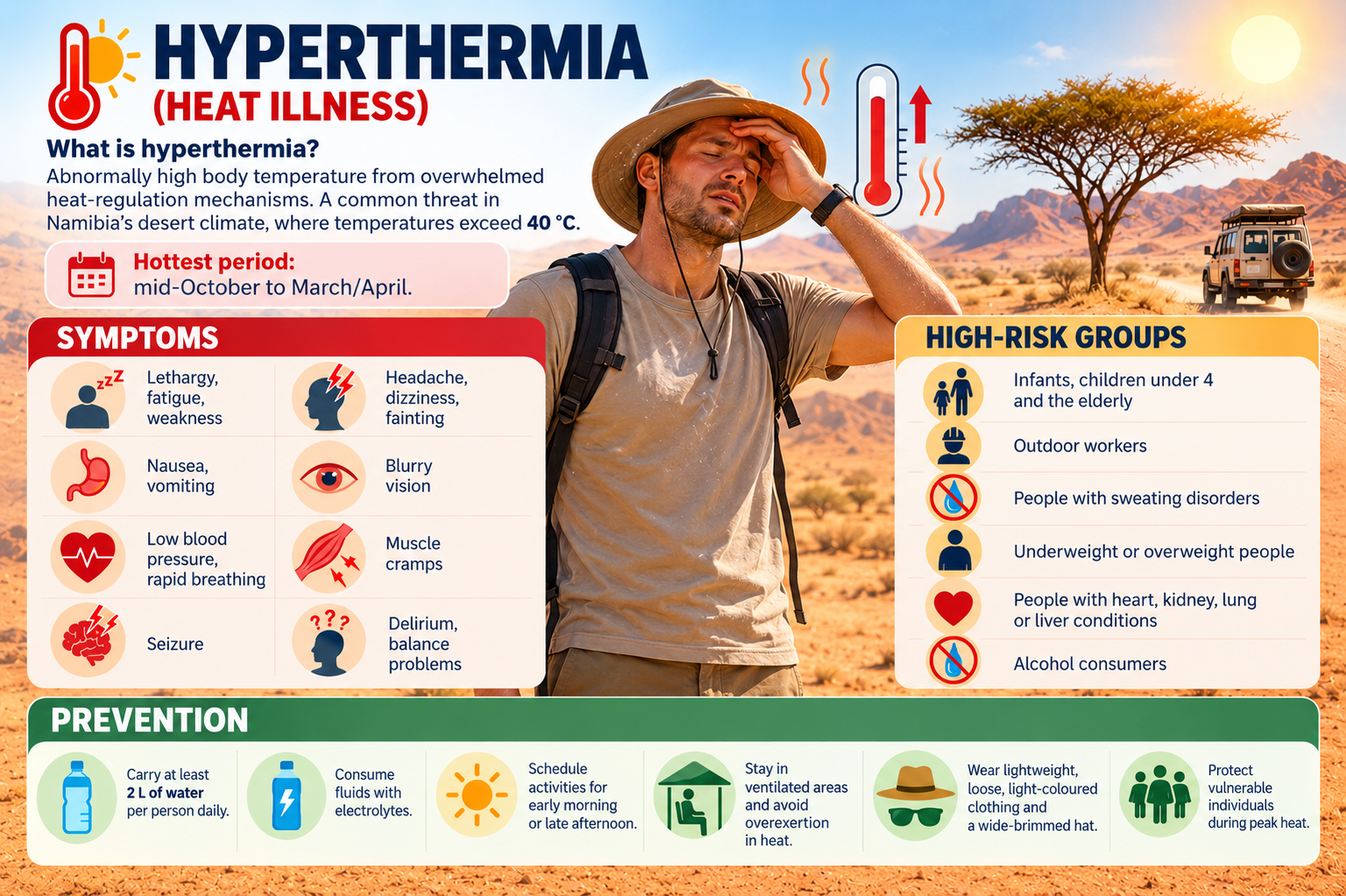
What is hyperthermia? Abnormally high body temperature from overwhelmed heat-regulation mechanisms. A common threat in Namibia’s desert climate, where temperatures exceed 40 °C.
Hottest period: mid-October to March/April.
Symptoms
- Lethargy, fatigue, weakness
- Headache, dizziness, fainting
- Nausea, vomiting
- Low blood pressure, rapid breathing
- Blurry vision, muscle cramps
- Seizure
- Anhidrosis (no sweating)
- Delirium, balance problems
High-risk groups
- Infants, children under 4, the elderly
- Outdoor workers
- People with sweating disorders
- Underweight or overweight people
- People with heart, kidney, lung or liver conditions
- Alcohol consumers
Prevention
- Stay in ventilated areas.
- Avoid physical overexertion in heat.
- Consume fluids with electrolytes.
- Carry a minimum of 2 L of water per person daily.
- Schedule activities for early morning or late afternoon.
- Protect vulnerable individuals during peak heat.
- Wear lightweight, loose, light-coloured clothing.
- Wear a wide-brimmed hat.
Treatment: cooling
- Find shade immediately.
- Stop all physical activity.
- Remove restrictive clothing and shoes.
- Apply a wet cloth to the palms, soles and cheeks (glabrous zones).
- Fan the body and ensure ventilation.
Treatment: rehydration
- Drink water steadily.
- Consume electrolyte fluids or powders.
Dehydration
The body is 60% water. Excessive fluid loss causes dehydration and electrolyte imbalance.
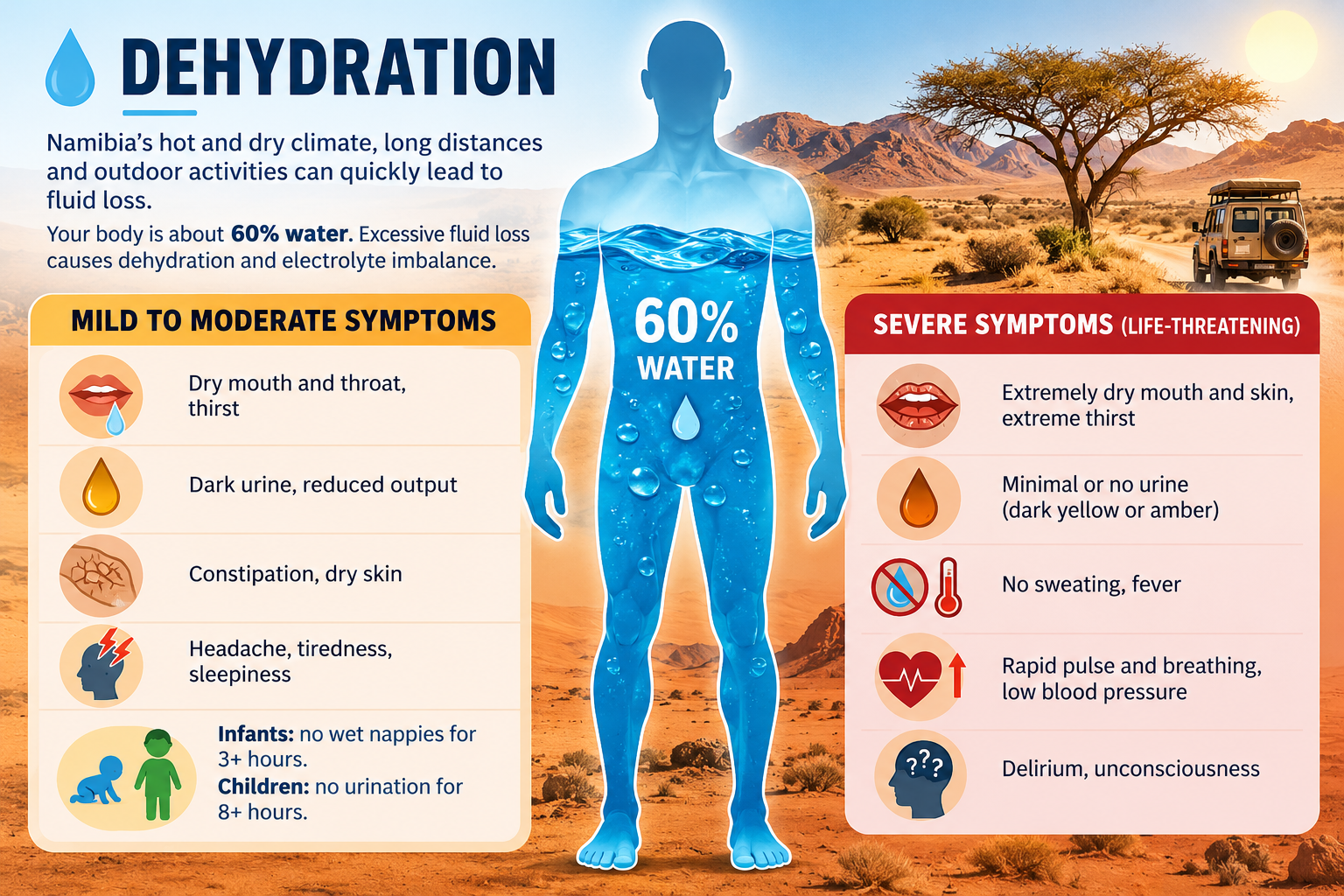
Mild to moderate symptoms
- Dry mouth and throat, thirst
- Dark urine, reduced output
- Constipation, dry skin
- Headache, tiredness, sleepiness
- Infants: no wet nappies for 3+ hours. Children: no urination for 8+ hours.
Self-treatment
Rehydration improves symptoms in 30 minutes to 3 hours. Sports drinks or Pedialyte provide electrolytes.
Prevention
- A minimum of 6 glasses (2 L) of fluid daily.
- Increase on hot days and during or after exercise.
- Use electrolyte fluids before, during and after exertion.
- Monitor urine colour: pale yellow is good, dark means dehydrated.
Management
- Mild: water, oral rehydration salts.
- General: two glasses of clear fluids every 2–4 hours (no diuretics: soda, caffeine or alcohol).
- Small, frequent amounts if vomiting or diarrhoea.
- Oral rehydration solutions.
- Rest, avoid heat and humidity, avoid ice-cold water.
Snake bites
Venomous snake bites can cause severe injury and sometimes death. If you are bitten by any snake, venomous or not, call your local emergency number or inform your lodge or campsite immediately, especially if the bitten area changes colour, begins to swell or is painful. Many emergency departments stock anti-venom which may aid in treatment of the bite.
Symptoms
Most bites occur on the extremities. Non-venomous bites cause pain or itching. In some cases, venomous snakes may inflict a “dry” (no venom) bite.
Venomous symptoms (within 15–30 minutes): severe burning pain, swelling and bruising spreading up the limb, nausea, laboured breathing, weakness, an odd taste, and neurological symptoms (tingling, difficulty speaking, weakness).
Common dangerous species

The puff adder: thick-bodied with geometric patterns, resembling a rattlesnake. Its danger comes from its docile nature: it doesn’t move when approached, making it easy to step on accidentally.

The cobra: classic hood display when threatened. Colours vary: black, grey, and the extremely dangerous zebra cobra (black and white bands). Body colours may differ from the hood.

The black mamba: Africa’s most feared snake. Highly aggressive and territorial. Despite the name, it’s grey or steel coloured: the “black” refers to the inside of its mouth. Extremely fast. Extremely venomous.
Treatment priorities
- Do not waste time. Get help and treatment immediately.
- Keep the patient calm. A lower heart rate reduces venom spread and shock risk.
- Get to medical care fast. Don’t neglect ANY confirmed snake bite.
CPR
Cardiopulmonary resuscitation (CPR) is an emergency procedure consisting of chest compressions, often combined with artificial respiration, to manually preserve intact brain function until further measures are taken to restore spontaneous blood circulation and breathing in a person who is in cardiac arrest. It is recommended for those who are unresponsive with no breathing or abnormal breathing.
How to do CPR
- Check scene safety, form an initial impression, and use personal protective equipment (PPE). Call for professional medical assistance IMMEDIATELY.
- If the person appears unresponsive, check responsiveness using the “shout, tap (shoulders), shout” technique. Check for breathing and life-threatening conditions.
- If the person is unresponsive, check the airway and mouth for any obvious blockage by a foreign object.
- Place the person on their back on a firm, flat surface. Be careful while doing so, and consider any other injuries you found in step 2 when moving them.
- Give 30 chest compressions:
- Hand position: two hands centred on the chest, roughly two finger widths from the bottom of the sternum (your centre chest plate).

- Body position: shoulders directly over hands, elbows locked.

- Depth of compression: 5 cm (2 inches).
- Rate: 100 to 120 per minute.
- Allow the chest to return to its normal position after each compression.
- Hand position: two hands centred on the chest, roughly two finger widths from the bottom of the sternum (your centre chest plate).
- Give 2 breaths:
- Open the airway to a past-neutral position using the head-tilt/chin-lift technique.

- Make each breath last about 1 second and make the chest rise. Allow air to exit before giving the next breath.
Note: If the 1st breath does not make the chest rise, re-tilt the head and ensure a proper seal before giving the 2nd breath. If the 2nd breath does not make the chest rise, an object may be blocking the airway.
- Open the airway to a past-neutral position using the head-tilt/chin-lift technique.
- If the chest rises as normal, continue giving sets of 30 chest compressions and 2 breaths until professional medical assistance arrives, or until someone with a higher level of training can take over.
Cold nights: hypothermia
Hypothermia occurs when body temperature drops below 37±2 °C. Despite its desert reputation, Namibia’s arid regions lose heat rapidly at night. Winter temperatures can reach −6 °C to −10 °C.
Coldest period: end of May/June to mid-September.
How the body loses heat
- Evaporation: water vaporises through the skin.
- Conduction: direct contact with cold objects.
- Convection: cold wind or water flow.
- Radiation: heat radiates from exposed skin.
Hypothermia vs hyperthermia
- Hypothermia: temperature drops below normal. The body loses heat faster than it produces it, and heat preservation is activated.
- Hyperthermia: temperature rises above normal. The body can’t expel heat fast enough, and heat loss mechanisms are activated.
- Treatment: warm a hypothermic patient, cool a hyperthermic patient.
Mild hypothermia (may not require urgent care)
- Increased heart rate
- Drowsiness, sluggish responses
- Constant shivering
- Numbness
- Pale, cold skin
Moderate hypothermia (seek medical attention)
- Altered consciousness
- No shivering
- Slowed heart rate, reduced breathing
- Falling blood pressure
- Kidney dysfunction
- Confusion, memory loss
Treatment (seek professional help)
- Move to a warm, dry place or shelter.
- Remove wet clothing and replace it with dry.
- Cover with blankets (focus on the torso first).
- Provide warm (NOT HOT) drinks. NO alcohol.
Sprains, strains and bruises
Soft tissue injuries are damage to muscles, ligaments or tendons from sprains, strains, impacts or overuse.
| Injury | What it is |
|---|---|
| Sprain | Ligament damage from stretching or tearing, e.g. falls or twisting. Common in wrists, knees and ankles. Swelling, tenderness, bruising, pain, can’t bear weight, discolouration, stiffness. |
| Strain | Muscle or tendon damage from stretching or tearing. Common in the foot, hamstring and back. Pain, tenderness, redness, bruising, limited motion, spasms, swelling, weakness. |
| Bruise (contusion) | Caused by blunt force. Pain, swelling and discolouration from internal bleeding. |
Treatment: R.I.C.E.
- Rest: avoid pain-causing activities, but maintain some movement.
- Ice: 15–20 minutes every 2–3 hours for the first few days.
- Compression: a light elastic bandage (don’t restrict circulation). Wrap from the farthest point toward the heart. Loosen it if pain, numbness or swelling increases.
- Elevation: keep the injury above heart level, especially at night.
Seek medical help for severe injuries.
Nosebleeds
Nosebleeds (epistaxis) are common in Namibia’s dry climate. Severe cases may cause nausea or vomiting, bleeding from both nostrils, or (rarely) low blood pressure.
Causes: trauma, low humidity, infections, sinusitis, rhinitis, environmental irritants. Most are self-limiting. Recurrent cases may indicate underlying issues.
Treatment
- Apply gloves.
- Pinch the nostrils.
- Lean the head FORWARD.
- Apply gauze to the nose opening.
- Secure it with a bandage (don’t block the mouth).
- Apply ice to the neck if available.
- Seek medical attention if bleeding continues for 15–20 minutes.

Travelling by road? See our driving guide for what to do if you break down.